Pages

Friday, September 13, 2013

Hermeneutics

Hermeneutics is the science or philosophy of interpretation. Five important types of hermeneutics are Natural, Normative, Scientific, Philosophical, and Depth.

As human beings, it is our instinct to communicate with others. Without communication and interpreting such messages, how would we ever know what one another was thinking? Hermeneutics has been around since ancient eras, such as when Aristotle and Plato were doing their teachings. People would listen to their messages and lessons and then interpret for themselves and maybe even find new ways to think about life itself.
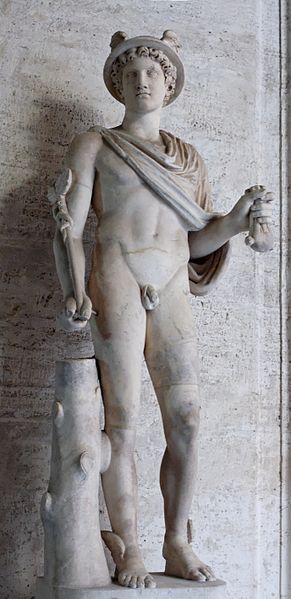
Statue of Hermes, Photo credit to Wikimedia Commons


Natural hermeneutics are our instinctual reactions. They are non-reflective, as they really give no existential meaning to our daily lives. It could just be something so much as saying "hello" to someone. It doesn't really stick with us. We don't dwell on it.

Normative hermeneutics encompasses all rules that all humans must abide by such as laws. Laws are stated for our well-being and we follow the rules to ensure the flow of society. Naturally, we do good things or just as easily, don't do bad things, so that we stay out of the radar of the law.

Scientific hermeneutics is centered around using science to develop messages. Scientific method is one example of this. Following the method will allow you to find a solution, thus completing the message.

Philosophical hermeneutics deals with philosophies such as ethos, pathos, and logos. Using these tools help humans to interpret messages with different feelings, emotions, or logic. Without these, our messages would be easily forgotten and have no meaning. It also allows us to think, what are we, instead of what we do as humans.

Depth in hermeneutics goes deeper than the conscious mind. It taps into the subconscious mind to unlock emotions or feelings that can trigger a new and different reaction. This way of interpreting messages can break us from oppression or social stigmas.

Hermeneutics is something that I had never really thought about, or even knew about. I think it is a new, interesting way for me, and now for you as well, to analyze how I react to messages or how others are reacting to our messages.

Wednesday, September 11, 2013

Superbowl Commercial - Frith Analysis

The Superbowl Commercial I chose was the Old Spice's Foxcrest - "Irresistible" advertisement.

Using the Frith Analysis method, as we can see from the "6-year-old's" perspective, there is a rugged, yet fancy looking man who has intimidating wolves strapped to his back and a high-class looking woman and they lock eyes during a soiree of sorts.

The advertiser's intended purpose is to get men to buy this line of smell-good product so that they can land a pretty lady friend. The nice clothes, party invite, and sporty, flashy car (along with smelling good) are all something men should aim for.

The cultural perspective is the typical guy-gets-girl theory. If a man uses this deodorant/spray/body wash, then he will be able to seduce a woman. The wolves represent power, strength, and maybe even protection. The party the pair are attending represents high class and wealth. While this is not seen in every men's body care line commercial, the original theme I mentioned is quite common.

At the end, the woman claims, "I never had a chance." I see this as she's mocking all men's scent commercials, saying that it happens every time a man carries the scent of Old Spice/Axe/what have you.

Tuesday, September 10, 2013

Wright Brothers Have the Right Stuff

By: Sarah Brown

December 17, 1903 -- Orville and Wilbur Wright, American brothers and flying enthusiasts, have invented the world's first airplane and successfully made the first controlled human flight in Kitty Hawk, N.C.

The Wrights began by building a biplane kite with a 5-foot wingspan. They noted that as the wings warped, the kite would change directions. They used that model to create their glider planes which were tested beginning in 1900 at Kitty Hawk because of the airflow from the Atlantic Ocean and the cushy sand to land upon.

Their models became bigger and better when they created a plane that could be controlled by the occupant and powered by a propeller and engine. After numerous engine and propeller failures, Orville finally took flight at 10:35 a.m. and lasted for about 12 seconds and gained a speed of 6.8 miles per hour.

"We are very pleased with our outcome. We have finally done it," Wilbur announced later that day.

The Wright brothers have paved the way for many new and unending prototypes to get humans flying high.

Sunday, September 8, 2013

Imagery: A Look Into Figurative Language - Comm 403


Imagery is standard in all forms of communication. All people use language to instill some sort of lasting impression on those whom they communicate with.

When we think about imagery, our brains do just that -- they create an image of what we think we see. The definition of imagery is the formation of mental images or pictures produced through figurative language.

One example I came up with was if I were to say "big blue shape", your brain could project any number of pictures. I could see a big, blue, fully colored circle and you could see a blue-lined triangle. Its almost like a Google Image search. You get tons of results, but maybe not the one you imagined.

There are millions of possibilities when it comes to using language to create a picture. When writing for the media, it is very important to create that image for publics.

We can also relate semiotics to imagery. We could all have different reactions to the same signs. Advertisements, such as billboards, may create vastly different reactions from some groups of viewers. Also, we can see this in hand gestures. Flipping the bird in the U.S. means something hurtful when shown to people. It might mean something very nice in another country or culture.

Imagery is a major part of how we, as humans, communicate sometime difficult messages to each other. It helps to make conveying said messages easier and more clear and concise. Without imagery and figurative language, we would be one huge world of confused human beings.